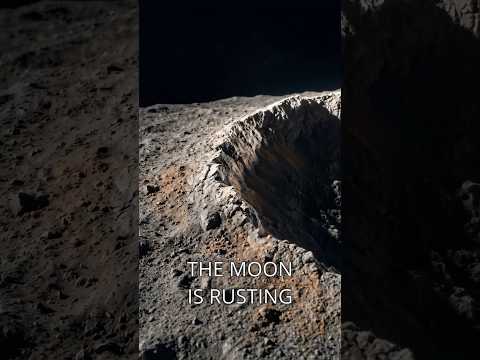
Rust… on the Moon. A world with no air, no rain, no rivers. And yet—something up there is quietly turning red.
A Dead-Gray World With a Red Secret
For most of human history, the Moon looked simple: grey dust, black shadows, nothing happening. No atmosphere means no weather, and “no water” used to sound like the end of the story. But scientists have spotted hematite on the lunar surface—an iron oxide better known as rust. It’s the same kind of mineral that helps make Mars look red.
Why Rust Shouldn’t Exist Up There
Rust, in the everyday sense, needs three ingredients: iron, oxygen, and water. The Moon has plenty of iron locked inside its rocks, so that part is easy. The problem is the other two. With no thick air to supply oxygen and almost no liquid water, the Moon should be a terrible place for rust to form. That’s why the discovery felt like finding smoke in a vacuum.
Earth Is Leaking Oxygen Into Space
Here’s the eerie twist: the Moon isn’t as alone as it looks. Earth’s upper atmosphere constantly sheds tiny amounts of oxygen into space—like a faint, invisible breath escaping our planet. As the Moon orbits Earth, it sometimes passes through Earth’s magnetic tail, a long region stretched away from the Sun. Inside that magnetic shadow, particles from Earth can dominate the environment around the Moon. That means oxygen from Earth can drift in and meet lunar rock, millions of kilometers from where it started.
The Moon Has Water… Just Not Like You Think
No oceans, no puddles, no rain. But the Moon does have water in small, strange forms: thin traces of water molecules trapped in the soil, and ice hidden in craters near the poles that never see sunlight. Think of it less like a wet world and more like a dusty room where a little moisture clings to the corners. Even tiny amounts can matter when the chemistry runs for millions of years. Near the poles—where cold traps water and sunlight arrives at low angles—the conditions can quietly favor oxidation.
The Perfect Moment: When Space Weather Changes the Rules
Most of the time, the Moon gets blasted by the solar wind—charged particles streaming from the Sun. That bombardment tends to strip and disturb surface chemistry, making delicate reactions harder to sustain. But when the Moon slips into Earth’s magnetic tail, it can be partially shielded from that solar assault. In those rare windows, Earth-supplied oxygen has a better chance to interact with iron in the lunar soil, with trace water acting like the silent helper. Not fast. Not dramatic. Just slow, stubborn chemistry—grain by grain.
A Red Stain That Tells a Bigger Story
Those rusty patches aren’t just a curiosity—they’re evidence. Evidence that the Moon is a kind of space-weather diary, recording interactions between Earth, the Sun, and everything that hits lunar ground. Micrometeorite impacts churn the surface, solar particles rewrite it, and Earth’s escaping oxygen adds a surprising signature. The Moon isn’t chemically “dead.” It’s just quiet about being alive with change.
The next time you look up at that calm grey face, remember: parts of it are blushing—because Earth is reaching it, one lost oxygen atom at a time.