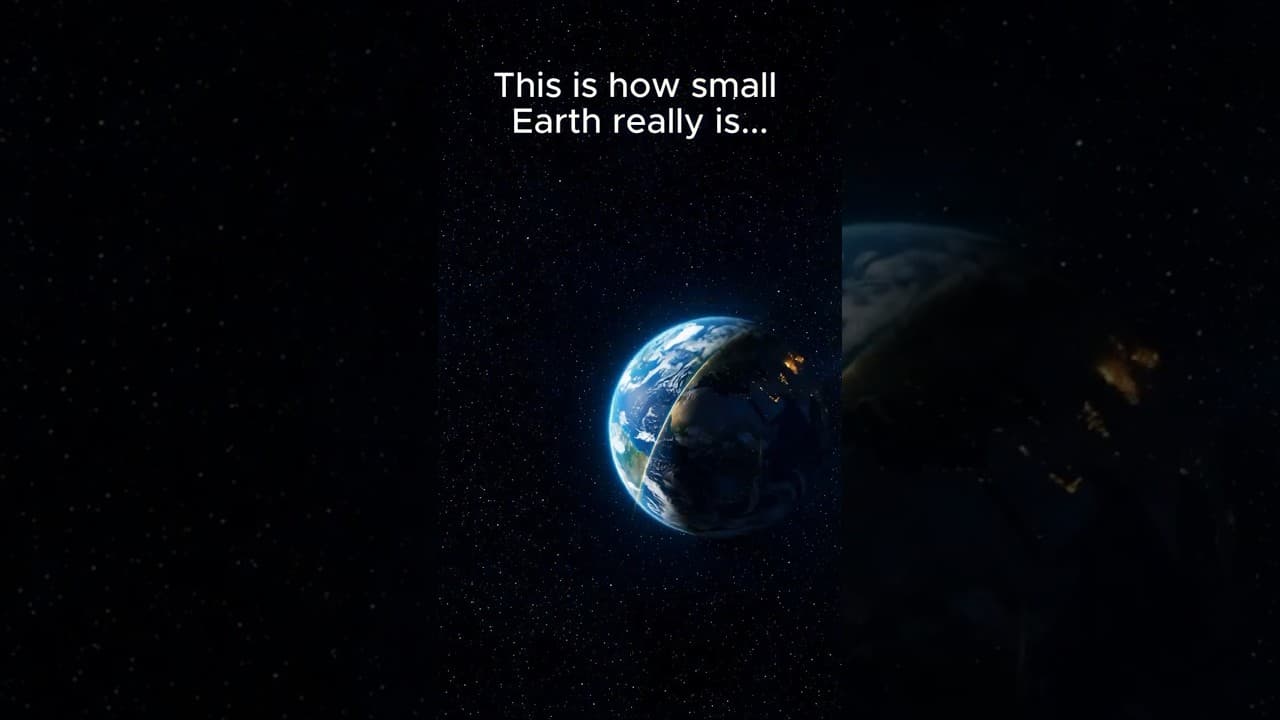
Earth looks big… until you put it next to the Sun. Suddenly our “giant world” becomes a dot. And the Solar System starts to feel… haunted by scale.
The moment Earth turns into a speck
On the ground, Earth is everything—oceans, mountains, storms, and cities stretching beyond the horizon. But place Earth beside the Sun and it’s like comparing a peppercorn to a beach ball. The Sun’s diameter is about 109 Earths wide, so it doesn’t just look bigger—it overwhelms the frame. It’s the same kind of shock you get when you zoom out of a map and realize your neighborhood was never “the world.”
A million Earths could hide inside
Here’s the part that tends to break people’s brains: you could fit over a million Earths inside the Sun. Not on the surface—inside the volume, like packing tiny marbles into a huge glowing sphere. Earth’s size feels infinite because we live on it, but volume doesn’t care about feelings. When you scale up a sphere’s width, the space inside grows insanely fast.
The Sun isn’t just bigger—it owns the place
Size is one thing. Power is another. The Sun holds about 99.8% of all the mass in the entire Solar System. That means almost everything that “counts” in terms of gravity is sitting in one blazing object, while the planets are basically leftover crumbs. If the Solar System were a giant pot of soup, the Sun would be almost all the soup—and the planets would be floating herbs.
150 million kilometers: the comfortable gap
Earth orbits at an average distance of about 150 million kilometers from the Sun. That number is so large it becomes meaningless—until you remember it’s the reason life survives here at all. A little closer and the oceans don’t stay oceans; a little farther and the world starts to freeze. And even at that “safe” distance, the Sun still dominates the sky, the seasons, and the rhythm of every day you’ve ever lived.
Most of the Solar System is empty on purpose
When people imagine the Solar System, they picture neat planets lined up like ornaments. In reality, it’s mostly emptiness—vast, quiet distances where nothing happens for millions of kilometers. That emptiness isn’t a mistake; it’s what stable orbits look like. Gravity is powerful, but space is bigger. So when you compare Earth to the Sun, you’re not only seeing a size difference—you’re seeing how the universe builds structure out of almost nothing.
The eerie takeaway
Earth feels like the main character because it’s where the story is happening. But next to the Sun, it’s a small, fragile world circling a star that contains nearly everything our system has. The shock isn’t that Earth is “small.” It’s that the thing we depend on—this brilliant, distant furnace—could swallow a million Earths and still have room to spare.
Stand on the ground if you want to feel big—then look up and remember what you’re really orbiting.